Flap Design Consideration In Palatal Surgery
Indications
Table of Contents
- Surgical procedures for palatal roots of maxillary molars and premolars for reprofiling, perforation repair, or root amputation
- Perforation or resorption repair of palatal surfaces of anterior teeth.
Read And Learn More: Endodontics Notes
Two flap designs mainly indicated for palatal surgery are:
- Triangular
- Horizontal
- In a triangular flap, the vertical releasing incision extends from marginal gingiva mesial to fist premolar to a point near the palatal midline and is joined by a horizontal intracellular incision which extends distally far as to provide access. Relaxing incisions are given between the fist premolar and canine to decrease the chances for severance of blood vessels
- The posterior part of the palate is pebblier which makes it a difficult area during elevation. Here, a scalpel can be used to partially dissect the tissues for a modified thickness flap.
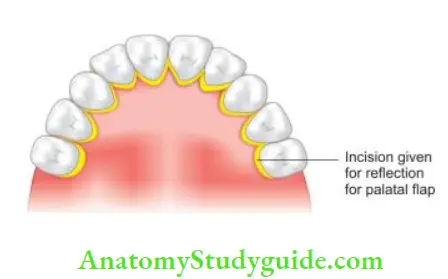
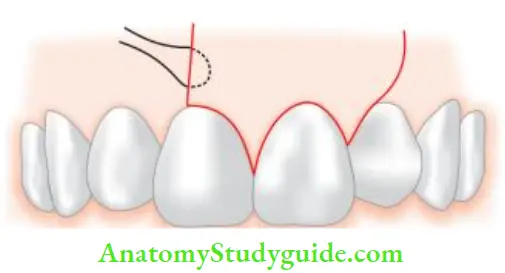
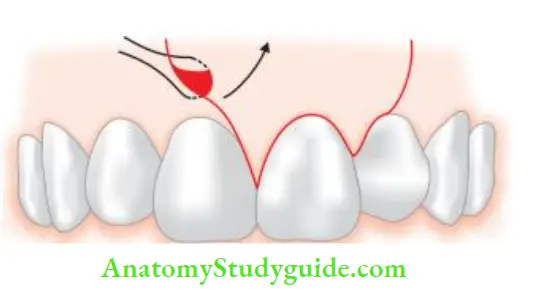
Flap Reflection And Retraction
- Reflection of a flap is the process of separating the soft tissues (gingiva, mucosa, and periosteum) from the surface of the alveolar bone
- It should begin in the vertical incision a few millimeters apical to the junction of horizontal and vertical incisions
- Once these tissues are lifted from the cortical plate, the periosteal elevator is placed between tissue and bone. It is moved coronally to separate marginal and interdental gingiva from the underlying bone and opposing incisional wound edge without direct application of directional forces.
- This elevation is continued until the attached gingival is lifted from the underlying bone to the full extent of the horizontal incision.
Flap Retraction
Retraction of the tissues provides access to the periradicular area. For this, the retractor should rest on the cortical bone with light but firm pressure directed against the bone. If the retractor rests on the base of reflected tissues, it can result in damage to the microvasculature of the alveolar mucosa and thus delayed healing.
Time of Retraction
The longer the flap is retracted, the greater are the complications of the following surgery because
- Vascular flow is reduced during retraction
- Tissue hypoxia may result causing delayed wound healing
- During retraction, the flip should be irrigated with normal saline to prevent dehydration of the periosteal surface of the flap. Because of the severance of the vertically oriented subperiosteal vessels, limited mucoperiosteal flaps are more susceptible to dehydration and thus require more frequent irrigation than full mucoperiosteal flaps.
Hard Tissue Management
After reflection of the flap, root apices are approached by making access through cortical plates. In case, radiolucency is present around the root apex, osseous tissue need not be removed surgically. But when radiolucency is not present periodically, osseous cutting is required to gain access to the root apex.
Tissue Response to Bone Removal
Bone in the surgical site has a temporary decrease in blood supply because of local anesthesia. This causes the bone to become more heat sensitive and less resistant to injury. So, any small changes during bone removal can affect bone physiology and viability.
Speed of Cutting
- At 8,000 pm: Almost similar tissue responses are seen when irrigation is done with or without a coolant or with a mixture of blood and saliva or water
- At high speed (up to 300,000 rpm): Favorable tissue response is noted when other parameters (coolant, pressure, type of bur) are controlled
Use of Coolant
Coolant (water, saline) should be used to dissipate heat generated during cutting osseous tissue and keep the cutting flutes of the instrument free of debris thereby reducing friction and using the cutting efficacy of the bur.
Types of Bur for Cutting
No. 6 or No. 8 round bur causes less inflammation and produces a smoother cut surface than produced by a fissure or diamond bur. It also reduces the healing time. Cutting bone with a diamond stone is the most inefficient as defects produced by these burs heal at a very slow rate.
Leave a Reply