• Skip to main content
  • Skip to secondary menu
  • Skip to primary sidebar
  • Skip to footer
  • Anatomy
    • Anatomy Question And Answers
    • Face Anatomy
    • Neck Anatomy
    • Head Anatomy
    • Oral Anatomy
    • Lower Limb
    • Upper Limb
  • Endodontics
    • Paediatric Dentistry
  • General Histology
    • Oral Histology
    • Genetics
  • Pediatric Clinical Methods
  • Complete Dentures
    • Pharmacology for Dentistry
  • Medical Physiology
    • Body Fluids
    • Muscle Physiology
    • Digestive System
    • Renal Physiology
    • Endocrinology
    • Nervous System
    • Respiratory System
    • Cardiovascular System
    • Reproductive System
    • Oral Physiology
  • General Medicine
  • General Pathology
    • Systemic Pathology
    • Oral Pathology
    • Neoplasia
    • Homeostasis
    • Infectious Diseases
    • Infammation
    • Amyloidosis Notes
  • Periodontology
  • General Surgery
    • Basic Principles Of Surgery
    • General Surgery

Anatomy Study Guide

Anatomy Study Guide

  • About Us
  • Contact Us
  • Privacy Policy
  • Terms of Use
  • Disclaimer
  • Sitemap
Home » Instruments For Fixed Prosthodontics Notes

Instruments For Fixed Prosthodontics Notes

June 10, 2023 by Joankessler parkland Leave a Comment

Instruments For Fixed Prosthodontics

Rotary Instruments For Tooth Preparation

Rotary instruments are used to grind the tooth (tooth preparation) to receive a crown or fixed partial denture.

Table of Contents

  • Instruments For Fixed Prosthodontics
  • Rotary Instruments For Tooth Preparation
  • Diamond Points
  • Contra-Angle Handpiece
  • Air Rotor Handpiece
  • Friction Grip To Latch Converter

Mainly two types of rotary instruments:

  1. Diamond points
  2. Tungsten carbide (TC) burs are used for tooth preparation.

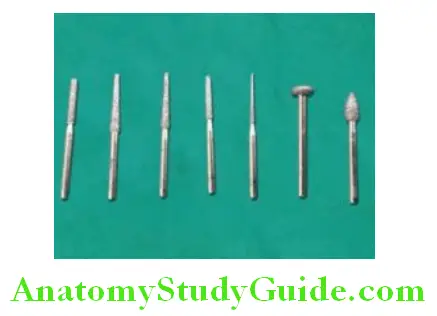
They are available in various shapes and grits. The diamond points are classified as coarse, medium course, medium fine, and super fine and coedlor-cod as red, green, blue, and yellow, respectively. They are rotary instruments used with contra-angled handpieces. Diamond points are widely used for tooth preparation.

Body Fluids Muscle Physiology Digestive System
Endocrinology Face Anatomy Neck Anatomy
Lower Limb Upper Limb Nervous System

Read and Learn  More: Preclinical Prosthodontics Notes
Instruments For Fixed Prosthodontics diamond points

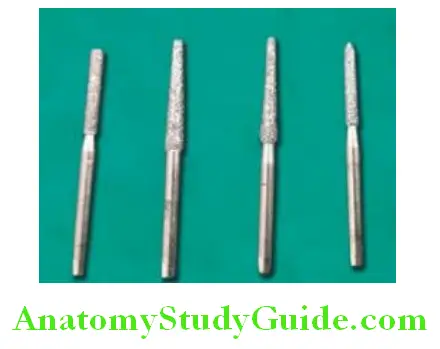
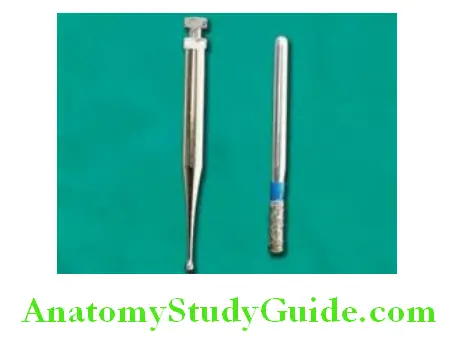
Diamond points to be used with micromotor handpieces and air-rotor handpieces are different. Diamond points used with micromotor handpiece have latch type nonworking end to attach it with micromotor. The diamond point or TC bur used with the air rotor has a straight nonworking end which is attached to the air rotor due to friction grip.

Diamond Points

These are commonly used rotary instruments for tooth preparation. The basic tooth preparation kit includes a straight fissure diamond, flat-end tapering diamond, rounded tapering diamond, torpedo-shaped diamond, long needle diamond, wheel-shaped diamond, and flame-shaped diamond.
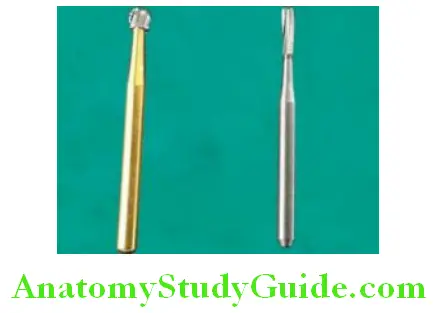
Instruments For Fixed Prosthodontics tungsten carbide burs

Instruments For Fixed Prosthodontics latch type and friction type nonworking ends of diamond points

Instruments For Fixed Prosthodontics diamond points.

Contra-Angle Handpiece

This is motor motor-driven handpiece. It gets power from an electric micromotor. This handpiece has high torque and low speed. In the contra-angle handpiece, the head of the handpiece is first angled away from the long axis and then back toward the long axis of the handle. Because of such design, the bur head lies close to the long axis of the handle of the handpiece which improves visibility and accessibility to the working field.
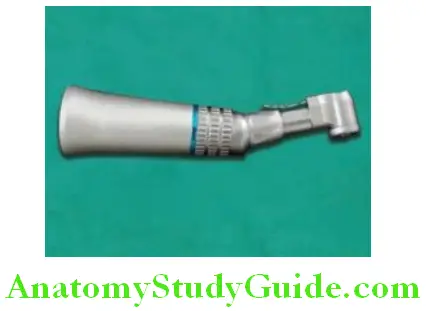
Instruments For Fixed Prosthodontics contra angle handpiece

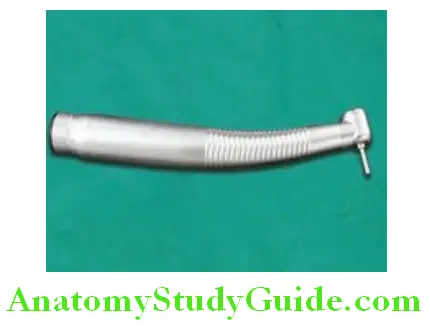
Instruments For Fixed Prosthodontics air rotor handpiece

This design also improves stability while working. Bur or diamond points with latch-type attachment/nonworking ends are used with contra-angle micromotor handpieces.

Air Rotor Handpiece

This handpiece gives very high speed but with lower torque than low-speed handpieces. It has a speed of 250,000–500,000 revolutions per minute (RPM). The high speed is achieved by a small air-driven turbine or rotor mounted in bearing the head of the handpiece.

The sink of the bur is inserted into the rotor of the handpiece and revolves with it. The handpiece always contains a system that directs water spray at the cutting end of the bur and often also contains fiber optic light for better visualization of the operating field.

Friction Grip To Latch Converter

This is a small converter that facilitates the use of friction grip bur/diamond with the contra-angle handpiece. On one end of the converter, a latch mechanism is provided while on the other end, there is provision to attach friction grip bur/diamond with the converter.
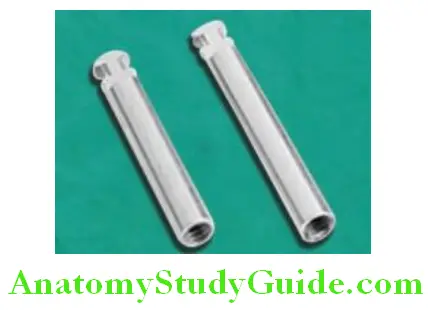
Instruments For Fixed Prosthodontics friction grip to latch convertor

Filed Under: Preclinical Prosthodontics

Reader Interactions

Leave a Reply Cancel reply

Your email address will not be published. Required fields are marked *

Primary Sidebar

Recent Posts

  • Esophagus Anatomy
  • Lacrimal Apparatus: Anatomy, Parts & Function
  • Scalp Temple And Face Question and Answers
  • Orbicularis Oculi Muscle Anatomy
  • Extraocular Muscles Anatomy
  • Ciliary Ganglion Anatomy
  • Femoral sheath Anatomy
  • Femoral Artery – Location and Anatomy
  • Adductor Canal: Anatomy And Function
  • Ankle Joint: Anatomy, Bones, Ligaments And Movements
  • Risk Factors For Breast Cancer
  • Cervical Tuberculous Lymphadenitis Notes
  • Carbuncles: Causes, Symptoms, and Treatments
  • Sinuses And Fistulas Notes
  • Cellulitis: Treatments, Causes, Symptoms
  • Pyogenic Liver Abscess: Causes, Symptoms, and Diagnosis
  • Acid Base Balance Multiple Choice Questions
  • General Surgery Multiple Choice Questions
  • Hypertrophic Scarring Keloids Multiple Choice Questions
  • Surgical Site Infection Multiple Choice Questions
  • Facebook
  • Pinterest
  • Tumblr
  • Twitter

Footer

Anatomy Study Guide

AnatomyStudyGuide.com is a student-centric educational online service that offers high-quality test papers and study resources to students studying for Medical Exams or attempting to get admission to different universities.

Recent

  • Esophagus Anatomy
  • Lacrimal Apparatus: Anatomy, Parts & Function
  • Scalp Temple And Face Question and Answers
  • Orbicularis Oculi Muscle Anatomy
  • Extraocular Muscles Anatomy

Search

Copyright © 2026 · Magazine Pro on Genesis Framework · WordPress · Log in