Complete Denture Introduction
Patients with no teeth in the oral cavity are known as completely edentulous patients. For such patients, complete dentures are fabricated to replace their missing teeth and associated structures. A complete denture is a dental prosthesis which replaces the entire dentition.
Table of Contents
They are usually a set of maxillary and mandibular dentures. Sometimes patients may need only a single complete denture either for the maxillary arch or for the mandibular arch when only one arch is edentulous.
Read and Learn More: Preclinical Prosthodontics Notes
Complete Denture Definition
Complete Denture:
A removable dental prosthesis that replaces the entire dentition and associated structures of the maxillae or mandible.
Aim and Scope of Complete Denture:
A complete denture replaces all the missing teeth in the oral cavity and restores the function. A large number of the world’s population is edentulous and facing difficulties in chewing and maintaining general health due to poor nutrition. Complete denture fabrication involves several steps that are crucial for successful treatment.
Various complete denture occlusal schemes and concepts make the complete denture a versatile treatment option for a variety of clinical situations. Implant-supported/retained complete denture provides longevity and better patient acceptance.
Surfaces Of Complete Denture
Sir Wilfred Fish (1948) described a complete denture as having three surfaces as follows:
Impression Surface/Intaglio Surface:
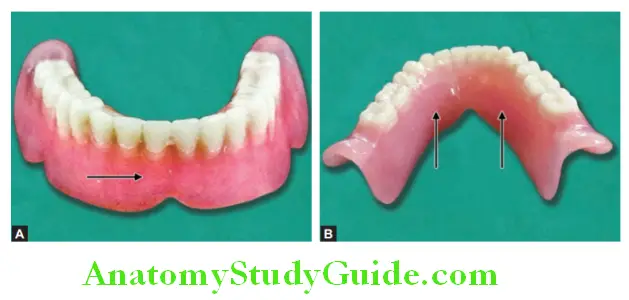
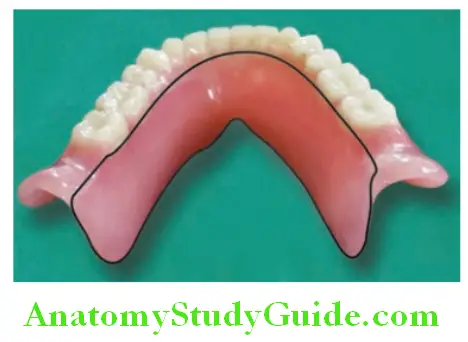
The portion of the denture surface that has its contour determined by the impression. This surface of a complete denture is in contact with the foundation area. The fit of dentures depends on the accuracy of the impression surface. It contributes to the retention, stability, support, and comfort of the prosthesis.

Occlusal Surface:
It is the occluding surface of the denture that establishes contact with the opposite denture while chewing and swallowing. This is actually occluding surfaces of artificial teeth or dentures. It helps in mastication and directs the masticatory forces to an edentulous foundation.
Polished Surface/External Surface/Cameo Surface:
The external surface of the denture is typically polished and includes the buccal, lingual, and labial surfaces of artificial teeth. This surface of the denture is in contact with the mucosa of the cheek, lips, and tongue. It contributes to the retention and stability of the denture.
Parts Of A Complete Denture
The complete denture has four parts in the Flowchart.
Denture Base:
That part of the denture rests on the foundation area (residual alveolar ridge) and stabilizes the denture on the foundation. It helps in the distribution of masticatory forces over



the foundation area. Extension of the denture base determines retention and support for the prosthesis.
Denture Borders:
The margin (border) of the denture base is at the junction of the polished surface and the impression surface. They are responsible for peripheral

seal and retention of complete dentures. If the border is overextended, it may cause ulceration and hyperplasia. Underextended borders compromise the retention and peripheral seal.

Cameo Surface Of Denture
Denture Flange:
Part of the denture base that extends from the cervical ends of the teeth to the denture border. It contributes to denture stability. It is classified according to the matching vestibule.
Labial Flange:
The portion of the denture flange extends into the labial vestibule. It provides lip support and aids in esthetics. A notch is created in the midline to house the labial frenum.
Buccal Flange:
The portion of the denture that extends into the buccal vestibule. It provides cheek support. A wide notch is provided for the buccal frenum.
Lingual Flange:
It is present only in mandibular dentures. It forms the portion of the mandibular denture that extends into the alveololingual sulcus. A notch is created for the relief of the lingual frenum. It should be in contact with the tissue of the oral floor.
Cameo Surface Of Denture
Denture Teeth:
These are artificial teeth or dentures. They are made up of different materials like acrylic, porcelain, interpenetrating polymer network (IPN), composite resin, and metal. They are available in different designs of the occlusal surface, i.e. anatomical, semi-anatomical, and non-anatomical.


Steps In Fabrication Of Complete Denture
Fabrication of a complete denture involves clinical and laboratory steps. The clinical steps and laboratory steps are given in Table.


Leave a Reply