Arm Attachments And Actions Of Biceps Brachii
Table of Contents
Read And Learn More: Anatomy Notes And Important Questions and Answers
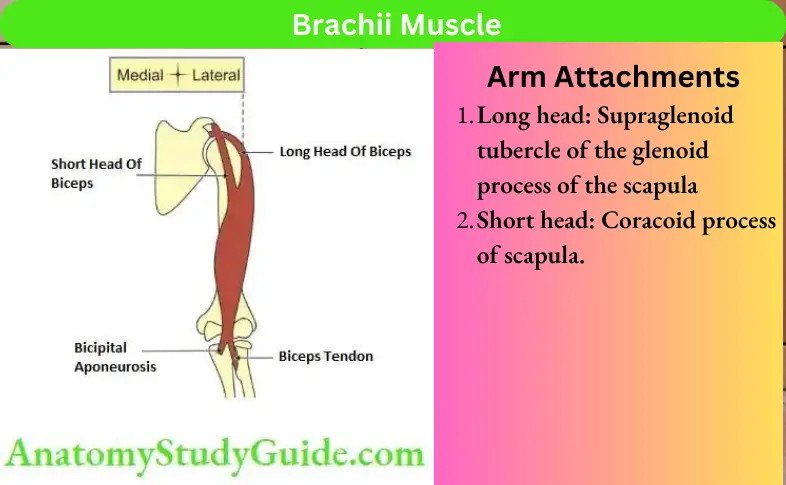
2. Arm Attachments Actions
- Strong supinator of superior and inferior radioulnar joints,
- Flexor of the elbow joint, and
- Weak flexor of the shoulder joint.
Question-1:Describe Musculocutaneous Nerve Under the Following Heads
1. Musculocutaneous Nerve Root value,
2. Musculocutaneous Nerve Course and relations,
3. Musculocutaneous Nerve Branches, and
4. Musculocutaneous Nerve Applied Anatomy.
Answer:
Musculocutaneous Nerve Introduction:
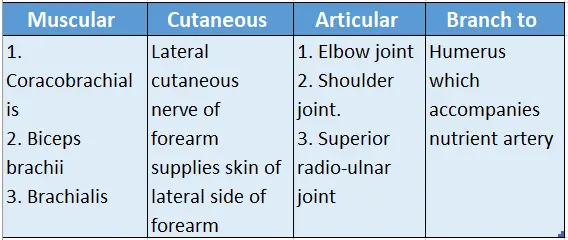
It is a branch of the lateral cord of the brachial plexus. It is the motor nerve of the flexor compartment of the arm and the sensory nerve to the lateral skin of the forearm.
1. Musculocutaneous Nerve Root value
C5, C6 and C7.
2. Musculocutaneous Nerve Course and Relations
It arises from the lateral cord of the brachial plexus.

1. The lateral cord of the brachial plexus lies lateral to the 2nd part of the axillary artery.
2. The nerve lies lateral to 3rd part of the axillary artery. It arises at the lower border of the pectoralis major.

In the axilla, it is related to the following structures.
- Anteriorly: Pectoralis major.
- Posteriorly: Subscapularis.
- Medially: Axillary artery.
- Laterally: Coracobrachialis.
It leaves the axilla, pierces coracobrachialis and enters the front of the arm.
In arm: It runs downwards and laterally.
- It passes between the biceps and brachialis.
- It pierces deep fascia just below the elbow and continues as the lateral cutaneous nerve of the forearm.
3. Musculocutaneous Nerve Branches and distribution
Distribution of musculocutaneous nerve
4. Musculocutaneous Nerve Applied anatomy
1. About the lesion of the musculocutaneous nerve.
- It is rare.
- It is due to a fracture of the neck of the humerus.
2. Lesion of the nerve causes:
- Loss of strong flexion and supination.
- Loss of biceps tendon reflex.
- Loss of sensation along the lateral aspect of the forearm.
- The pain and anaesthesia may be aggravated by the extension of the elbow.
3. Myotrophy: Marked weakness of flexion of the elbow is due to paralysis of the bicep brachii and coracobrachialis.
4. The nerve may be involved in Erb’s paralysis.
5. The musculocutaneous nerve in a cadaver is identified as
- First, identify the coracoid process.
- The medial muscle arising from the coracoid process is the coracobrachialis.
- The nerve piercing the coracobrachialis is the musculocutaneous nerve.
6. Biceps reflex: The integrity of the musculocutaneous nerve is tested by the biceps reflex. It is tested by tapping the tendon of the biceps brachii with the forearm pronated and partially extended at the elbow. The normal reflex is a brief jerk-like flexion of the elbow.
7. Surgical approach: The musculocutaneous nerve is exposed by opening up the deltopectoral groove. The nerve entering the coracobrachialis is identified as the musculocutaneous nerve. Here it lies below the lower border of Teres Major.
The muscles which are supplied by the musculocutaneous nerve can be remembered and recollected by putting the palmar surface of one band on the arm of the other side and saying “BBC” and by putting the hand on the lateral surface of the forearm and while saying it continues as “lateral cutaneous nerve of the forearm”.
The first letter “B” in “BBC” stands for “Biceps“.
The second letter “B” in “BBC” indicates “Brachialis“.
While the letter “C” in “BBC” represents” Coracobrachialis“.
Here I would like to draw your attention to the fact that the brachialis has a dual nerve supply. The musculocutaneous nerve supplies the medial 2/3rd of the brachialis and the lateral 1/3rd is supplied by the radial nerve.
Hence brachial is called MR brachialis. The letter “M” in “MR” indicates musculocutaneous and “R” stands for radial nerve.


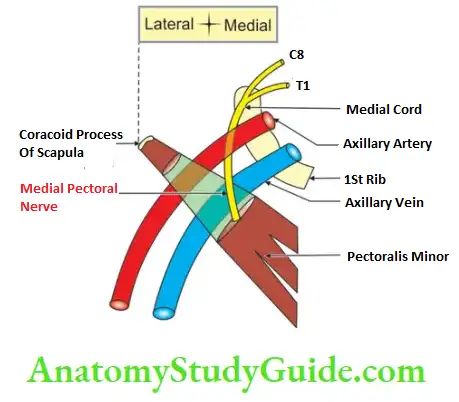
Medial Pectoral Nerve
- It arises from the medial cord, hence it is called the medial pectoral nerve.
- It arises from the anterior primary rami of the 8th cervical and 1st thoracic spinal nerve.
- It supplies pectoralis minor,
- It pierces the sternal fibres of the pectoralis major and supplies it.
- It has no cutaneous branch.
Medial Cutaneous Nerve Of Forearm
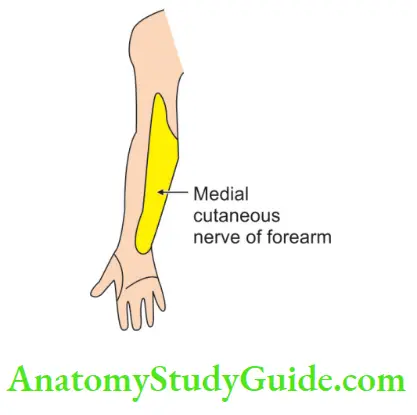
The medial cutaneous nerve of the forearm
- It arises from the anterior primary rami of C8 and T1.
- It is the smallest branch of the brachial plexus.
- It is much bigger than the medial cutaneous nerve of the arm.
- It runs between the axillary artery and vein and pierces the deep fascia at the middle of the arm.
- It supplies the skin over the biceps, almost to the elbow.
- It then divides into anterior and posterior branches.
- It supplies the skin along the ulnar border of the forearm up to the wrist.
- It is symmetrical with the lateral cutaneous nerve of the forearm.
- These cutaneous nerves meet along the anterior axillary line.
Question-4: What Structures Pass Between The Medial And Lateral Head Of The Triceps
Answer:
- Radial nerve,
- Profunda brachial artery, and
- Profunda brachial vein.

Boundaries Of Cubital Fossa
- Medially by the lateral border of pronator teres, and
- Laterally by the medial border of brachioradialis.
Contents Of Cubital Fossa
1. Radial nerve and its terminal branches
- Superficial branch, and
- The posterior interosseous nerve.
2. Bicipital aponeurosis
3. Brachial artery and its terminal branches
Larger ulnar artery
1. Anterior ulnar recurrent,
2. Posterior ulnar recurrent,
3. Common interosseous,
- Anterior interosseous, and
- Posterior interosseous.
4. Smaller radial artery and its branch-radial recurrent
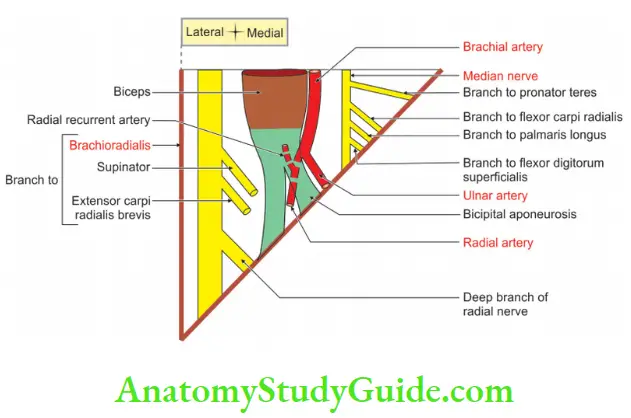
4. Brachial vein and its tributaries
5. Median nerve and its branches
Muscular artery
- Flexor carpi radialis,
- Palmaris longus,
- Flexor digitorum superficialis, and
- Flexor digitorum profundus (lateral half).
Applied Anatomy Of Cubital Fossa
1. The median cubital vein is the most fixed vein. Hence it is used for the withdrawal of blood for investigation purposes and for giving intravenous fluid.
2. The brachial artery is auscultated for recording blood pressure.
3. The brachial artery is selected for the withdrawal of arterial blood for blood gas analysis.
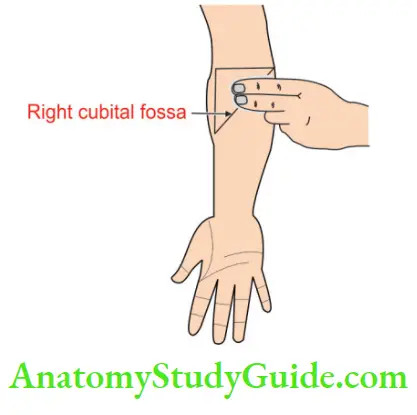
4. The cubital vein is used for the introduction of the cardiac catheter to secure blood samples from the great vessels and chambers of the heart.
5. The supracondylar fracture of the humerus results in the rupture of the brachial artery. It results in Volkmann’s ischaemic contracture.
Leave a Reply