Antimalerial Agents Introduction
Malaria is one of the most widespread diseases caused by protozoan parasite of the genus, Plasmodium. These parasites spend an asexual phase in man and sexual phase in female anopheles mosquito. Malaria is caused by four species of one-cell protozoan of the Plasmodium genus: P. falciparum, P. vivax. P. malariae and P. ovale. No antimalarial drug is effective against all four species.
Table of Contents
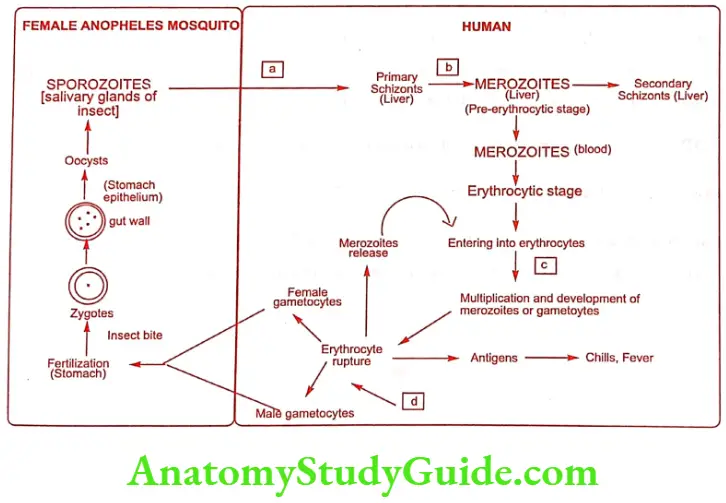
The mosquito stores the sporozoite form of the protozoan in its salivary glands. Malarial infection is initiated through the bite of infected mosquito into the human blood stream. The sporozoite in the blood stream enters into the parenchyma cell of host liver, where they become primary schizonts and then merozoites. Depending upon the plasmodium the merozoites either rupture the infected hepatocytes and enter the systemic circulation or infect other liver cells.
Merozoite now enters into the circulation and invades erythrocytes, where they reside for 3 to 4 days and reproduce. The reproduction stage in the erythrocyte can produce either more merozoites or another form called gametocytes. Due to this repeated multiplication erythrocyte may rupture and release merozoites into the circulation. Each merozoite again invades fresh erythrocytes and the cycle of asexual multiplication is repeated again. This stage is known as schizogony phase of infection which causes severe fever and chills.
When such infected blood was ingested by a female anopheles mosquito, the gametocytes (male and female) undergo sexual reproduction within the gut of the insect. The resulting zygotes through various stages of development migrate as sporozoites to the mosquito salivary gland. The cycle begins when a mosquito bites a human.
Site of antimalarial agents: (from diagram):
- Kills the sporozoites injected by the mosquito and/or prevails the entering of sporozoites entering the liver. The drug used in this stage is known as a prophylactic agent. Since no drug is effective in this stage, true prophylaxis does not exist for malarial parasites.
- Drug active against erythrocyte phase. These drugs are known as schizonticidal agents.
- Example: Amodiaquine, Chloroquine, Quinine, Promethazine.
- Kills the merozoites in the blood and/or prevents their multiplication, known as a suppressive agent.
- Example: Chloroquine, Amodiaquine.
- Kills the gametocytes before they enter the mosquito and reproduce into zygotes.
- Example: Primaquine.
Antimalarial Agents Classification
Antimalarial agents are chemically classified as:
- Cinchona alkaloids :
- Example: Quinine, Cinchonine.
- 4- Amino quinolines :
- Example: Chloroquine, Amodiaquine, Hydroxy chloroquine.
- 8 – Amino quinolines :
- Example: Bulaquine, Primaquine, Pamaquine.
- 9- Amino acridine :
- Example: Mepacrine.
- Biguanides :
- Example: Proglacial, Cycloguanil.
- Pyrimidine analogue :
- Example: Promethazine.
- Polycyclics :
- Example: Doxycycline, Halofantrine.
- Newer antimalarial agents :
- Example: Artemisinin, Fosmidomycin.
- Sesquiterpene lactones :
- Example: Arte ether, Arteemether, Artesunate.
- Miscellaneous :
- Example: Mesalamine, Sulphadoxine, Mefloquine.
Cinchona Alkaloids
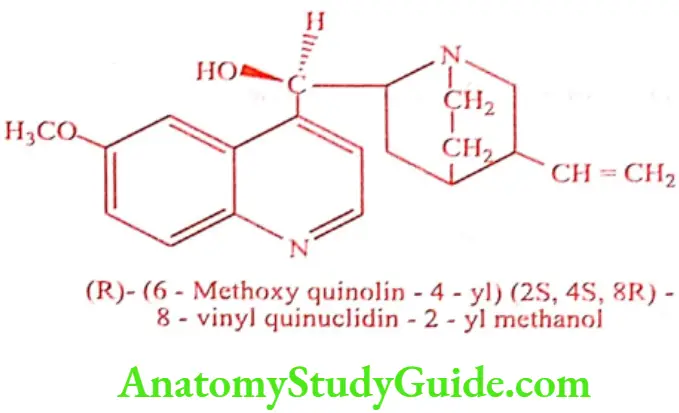
Quinine was the first known antimalarial obtained from Cinchona officials. It is a 4-quinoline methanol derivative bearing a substituted quinuclidinyl ring. Four stereo isomeric chiral centres exist in the molecule at C-3, C-4, C-8, and C-9. Quinine absolute configuration of 3R: 4S: 8S: 9R and their optical isomers have antimalarial activities. The dextro isomer of Quinine is Quinidine which is used as an antiarrhythmic drug.
Quinine (Quinex, Quiner)
It is a di-acid tertiary base and it forms salts with two equivalents of acid. It is a natural white crystalline alkaloid having antipyretic, analgesic antimalarial and antipyretic properties with bitter taste. It contains two major fused ring systems namely aromatic quinoline and bicyclic quinuclidinyl.
ADR: Cinchonism characterized by tinnitus, impaired hearing, disturbed vision, nausea and vomiting.
Dose: 650mg given every eight hour for 7 days.
Use: It is used to treat Chloroquine resistant strains of Plasmodium falciparum.
4-Aminoquinolines
The 4-substituted quinoline rapidly acts against Plasmodium in the erythrocytic stage. They act by intercalating into the DNA of the parasite.
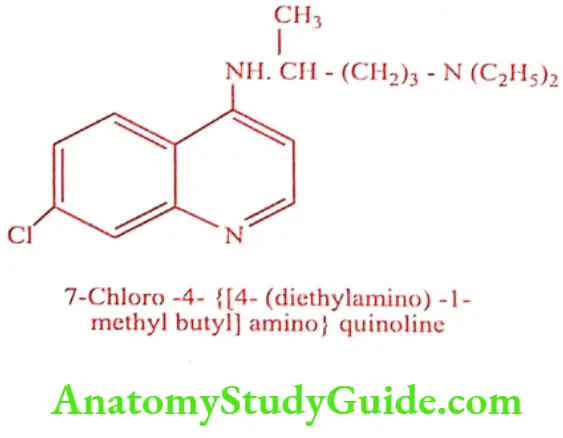
Chloroquine (Cadiquin, Melubrin)
It prevents the development of malaria parasites in the blood. It does not destroy the Plasmodium vivax and Plasmodium ovale parasites that may remain in the liver. The phosphate salt is used in oral dosage form and hydrochloride salt is used in parenteral formulation.
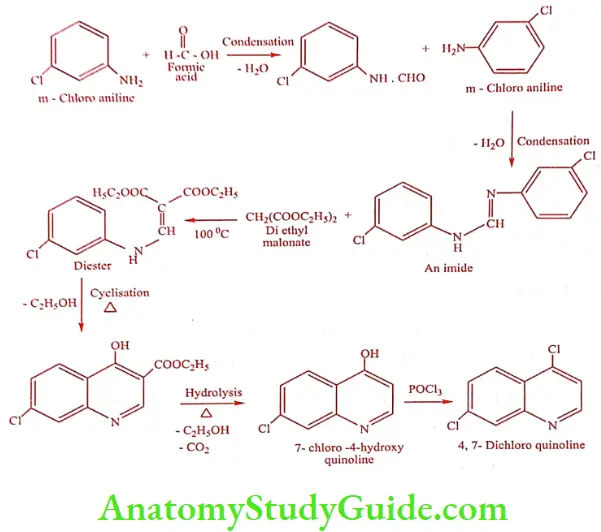
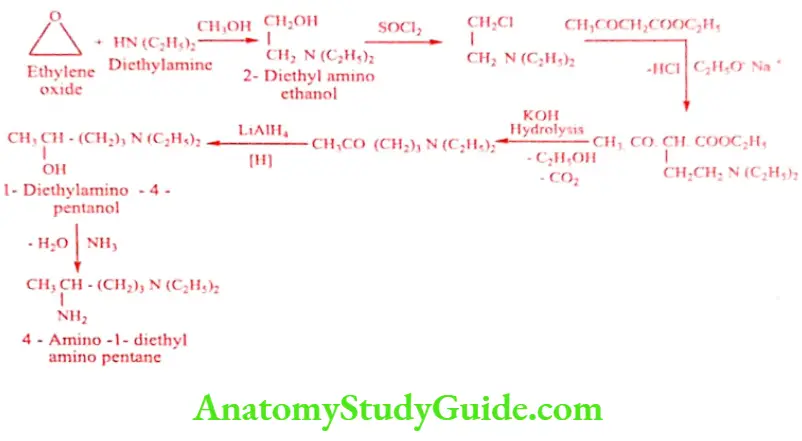
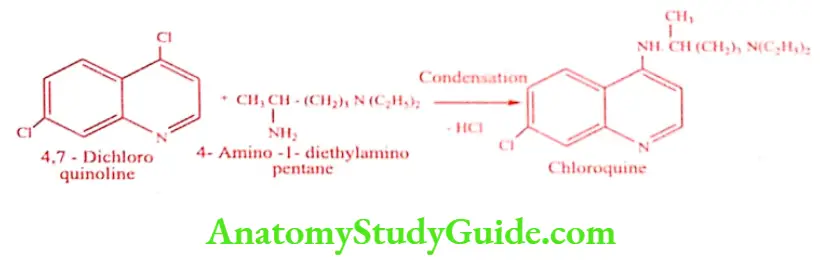
Synthesis
Step 1: Preparation of 4, 7 – Dichloro quinoline
Step 2: Preparation of 4 – Amino – 1 – diethylamino pentane
Step 3: Condensation of step I and step II products
ADR: Retinopathy, hair loss, photo sensitivity, tinnitus, sleep disturbances, nausea, head ache, itching and myopathy.
Dose: 300mg once weekly and continued for at least 4 weeks after exposure.
Use: It is used for both prophylaxis and treatment. It is found to be quick schizonticidal agent.
Hydroxy chloroquine (Hqtor, Winflam)

Synthesis

ADR: Retinopathy, hair loss, photo sensitivity and tinnitus.
Dose: Initially 800mg followed by 400mg, 6 to 8 hours later, then a further 400mg on each of the succeeding two days.
Use: It is used both for prophylaxis and treatment.
Amino quinolines
Primaquine (Pmq, Malquine)

Synthesis

ADR: Nausea, vomiting and epigastric distress.
Dose: 15mg daily for 14 days.
Use: It is the only 8-Amino quinoline currently in use for the treatment of malaria. It is active against exoerythrocytic Plasmodium vivax malaria and also inhibits gametocyte stage.
Bulaquine (Aablaquin)

Bulaquine (Aablaquin) ADR: Specific studies with other drugs have not been undertaken except with Chloroquine where it was concurrently used in the phase II/III clinical trials without any adverse effects.
Bulaquine (Aablaquin) Dose: 25mg once daily for 7 days.
Bulaquine (Aablaquin) Use: It is used in the treatment and prevention of Plasmodium vivax malaria.
Pyrimidine Analogues
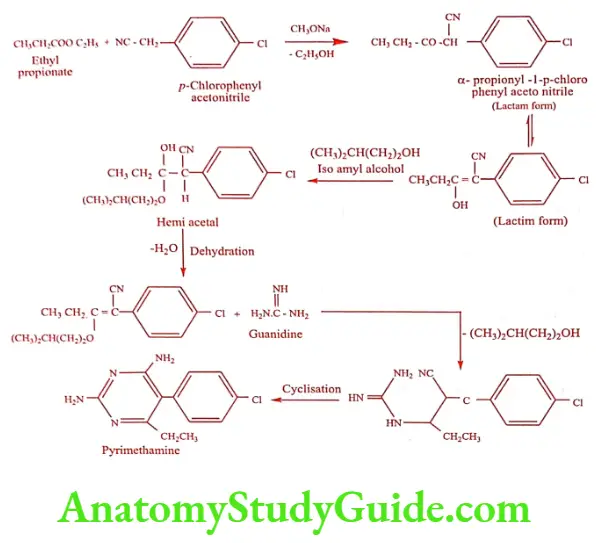
Pyrimethamine (Paraffin, Malasulf)
It is a medication for most of the protozoal infections. It is in the treatment of Toxoplasma gondii in immune-compromised patients such as HIV-positive individual in combination with Sulfadiazine. It act by interferes with tetrahydrofolic acid synthesis from folic acid by inhibiting the enzyme dihydrofolate reductase.

Synthesis
Promethazine ADR: Urticaria, photosensitization and arthralgia.
Promethazine Dose: 25mg as a single dose.
Promethazine Use: It is used in suppressive prophylactic for the prevention of severe attack due to malaria parasite
Sesquiterpene Lactone
Arteether (Acter)

Arteether ADR: Head ache, nausea, cough and dizziness.
Arteether Dose: 150 mg once daily for 3 consecutive days.
Arteether Use: It is used in the treatment of Chloroquine resistant Plasmodium falciparum malaria and cerebral malaria cases.
Artemether (Larither, Paluther)

Artemether ADR: Mild GI disturbance, dizziness, tinnitus, nausea and vomiting.
Artemether Dose: 80mg daily, to be taken along with Lumefantrine 480mg daily.
Artemether Use: It is used in suppressive prophylactic for the prevention of severe attack due to malaria parasite.
Artesunate (Asunate, Ulteria)

Artesunate ADR: Mild nausea, vomiting, abdominal pain, itching and drug fever.
Artesunate Dose: 100mg, twice a day.
Artesunate Use: It is effective in the treatment of falciparum gametes.
Miscellaneous
Mefloquine (Mqf, Mefque)

Mefloquine ADR: Nausea, vomiting, abdominal pain and diarrhea.
Mefloquine Dose: 20 to 25mg/ kg as a single dose or preferably in 2 or 3 divided doses at 6 to 8 hrs interval.
Mefloquine Use: It is effective against the erythrocytic form of malaria.
Sulphadoxine (Malocide, Malasulf)

Sulphadoxine is an antibacterial group; it is used in combination with Pyrimethamine. The Sulphadoxine interferes with the parasite ability to synthesis folic acid and Pyrimethamine inhibits the reduction of folic acid to its active tetrahydrofolate coenzyme form. The synergistic antifolate combination of Sulphadoxine a long-acting sulphonamide with Promethazine is used to treat malaria. The combination is considered as schizonticidal.
Sulphadoxine ADR: Urticaria, photosensitization and arthralgia.
Sulphadoxine Dose: 500mg as a single dose.
Sulphadoxine Use: It has antibacterial activity. In combination with Trimethoprim it is used as antibacterial agent, with Pyrimethamine and Mefloquine it is used as antimalarial.
Leave a Reply