Complete Denture Impression Introduction:
For complete denture fabrication two impressions are made, i.e. primary impression and final impression. Different impression materials and impression trays are used for primary and final impressions. This chapter is about complete denture impressions.
Table of Contents
Complete Denture Impression Definition
Impression:
A negative likeness or copy in reverse of the surface of an objects.
Read and Learn More: Preclinical Prosthodontics Notes
Objectives Of Complete Denture Impression Making
Preservation of Remaining Oral Tissue:
It is always better to preserve what is remaining than to replace what is lost. The present health of oral tissue should be taken care while making impression or during prosthesis fabrication as it serves as foundation for prosthesis.
Be careful while making impression and avoid trauma to oral tissue. One should cover maximum foundation area in impression to divide masticatory force over wider area and minimize the resorption.
Provide Retention, Stability, Support, and Esthetics for the Denture:
Retention:
It is resistance of the prosthesis to the force acting in vertical direction away from the foundation. Prosthesis should resist its removal when vertical force is applied against the path of insertion or path of placement of denture. There are various factors which contribute for retention in complete denture. These factors are adhesion, cohesion, interfacial surface tension, and peripheral seal.
Stability:
The property of prosthesis to be firm, steady, and resist the horizontal or rotational forces applied on it. If horizontal forces are applied to denture during various routine activities it should not become loose. Factors affecting stability are thickness of denture border, contouring of polished surface, occlusal plane, neuromuscular control of patient, and adaptation of prosthesis with ridge slopes.
Support:
The ability of denture to resist vertical forces directed toward the foundation (Retention: Forces in vertical direction but away from foundation). Support depends on wide coverage of foundation area. Other factors affecting supports are amount of residual alveolar ridges, shape of palatal vault, buccalself area, etc.
Achieve Esthetic:
While making impression one should properly contour the borders and should get proper support for lips and cheeks. This will contribute in final outcome of denture esthetic.
Impression Techniques For Making Edentulous Impression
Depending on Mouth Position While Making Impression:
Closed Mouth Impression Technique:
Occlusal rims are attached with impression trays and patient applies pressure on them. The tissue is recorded in displaced or functional position.
Open Mouth Impression Technique:
Commonly used technique. Tissue is recorded in undisplaced condition. Mouth is partly opened and impression tray is held in position while making impression.
Depending of Pressure Applied on Oral Mucosa by the Impression Material While Making Impression:
Mucocompressive/Pressure Technique (Green Brothers):
According to this technique tissue of oral cavity is recorded under pressure in their functional state. Pressure is applied on both stress bearing and nonstress bearing areas. Materials used for this technique are impression compound and impression waxes.
Mucostatic (Minimum Pressure Technique (Harry L Page):
According to this theory interfacial surface tension is the only factor responsible for denture retention. Pressure applied is very minimum and border molding is not done. Hence, the tissues are recorded in their rest position. Materials used for this technique are impression plaster and low viscosity material like light body.
Selective Pressure Technique (Boucher):
This theory combines advantages of both mucocompressive and mucostatic techniques. Mucocompressive concept is used while recording stress bearing areas and mucostatic concept used in recording relieving areas. Spacer is used to relieve relieving areas while making impression with custom impression tray. Border molding is done with custom tray. Material used for this technique is zinc oxide eugenol impression paste.
Modified/Special Impression Technique:
- Flabby tissue
- Poor foundation
- Microstomia (sectional impressions).
Types Of Edentulous Impression
Primary/Preliminary/Diagnostic Impression:
This impression is made for diagnosis and treatment planning of particular patient. The cast obtained by pouring this impression is used for fabrication of custom tray to make final impression.

Secondary/Final/Master Impression:
The final impression records fine details and proper border extensions. The cast retrieved after pouring final impression is used for fabrication of the complete denture and to achieve objectives of impression, i.e. retention, stability, support, preservation of tissue and esthetic.
What Should Be Recorded In An Impression?
The maxillary impression should record labial and buccal frenums attachments, labial and buccal vestibule, residual alveolar ridge, palate, hamular notches, posterior palatal seal area, and coronomaxillary area.
The mandibular impression should record all frenum attachments, labial and buccal vestibule, buccal-self area, retromolar pads, sublingual area, mylohyoid ridge, retromylohyoid space, and sublingual crescent area.
Primary Impression
Definition:
A negative likeness made for the purpose of diagnosis, treatment planning or for the fabrication of a tray.
Rationale/Need
Primary impression for complete denture should cover all landmarks and borders of denture foundation area. It should be accurate because it is used to pour primary cast on which custom tray is fabricated, which is used to make final impression. Mucocompressive technique is used for making primary impression with impression compound.
Materials Used For Making Primary Impression
Impression Compound:
Most commonly used primary impression material is impression compound. This material is rigid in nature; it becomes hard and inelastic after setting. It can be successfully used for making impression of denture foundation with no undercuts. If undercuts are presents then impression compound will not come out from undercuts, it may get distorted or may injure the mucosa and hence it is not advised for such undercut foundation.
Irreversible Hydrocolloid (Alginate) Impression Material:
Sometime there are unilateral or bilateral undercuts present on the edentulous foundation area. In such cases impressions made with impression compound may not come out easily without distortion. In such
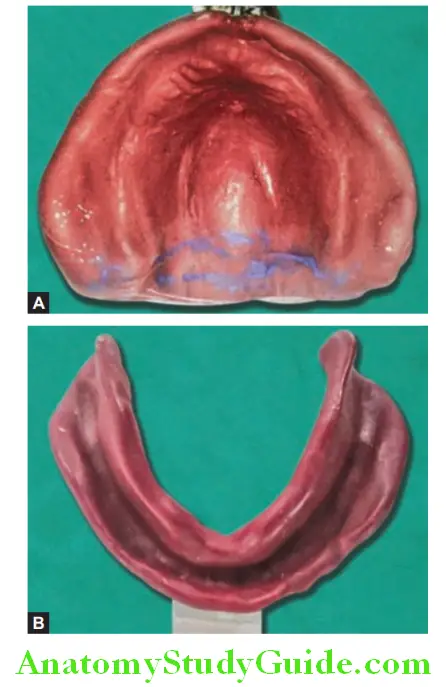
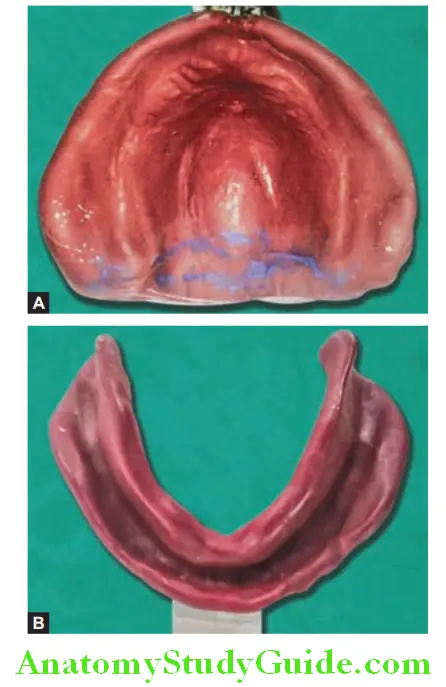
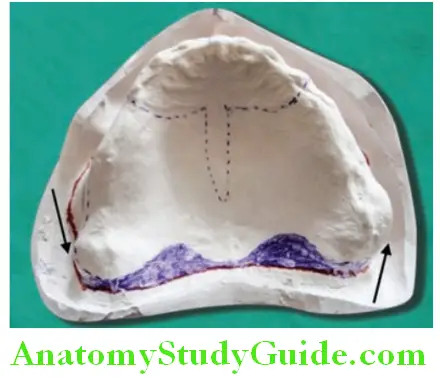
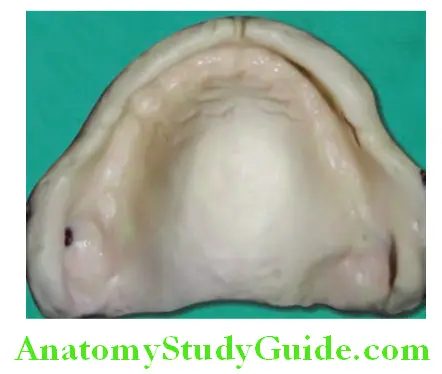
patients, impression should be made with elastic material. Irreversible hydrocolloid is commonly used for this type of patients. As it is elastic in nature, it will allow easy removal of set impression without distortion of impression and without injury to patient. In some cases putty consistency of elastomeric impression material is also used.
Impression Trays For Primary Impression
If impression material selected is impression compound then nonperforated edentulous stock trays are used. If material of choice for primary impression is irreversible hydrocolloid then perforated edentulous stock trays are used.
Final Impression/Secondary Impression
Final impression of complete denture comprises of two di erent steps as follows:
- Border molding
- Impression of denture foundation.
Definition:
Secondary impression: The impression that represents the completion of the registration of the surface or object. Border molding: The shaping of the border areas of an impression tray by functional or manual manipulation of the tissue adjacent to the borders to duplicate the contour and size of the vestibule, OR Determining the extension of the prosthesis by using tissue function or manual manipulation of the tissues to shape the border areas of an impression material.
Border Molding:
In border molding, material is added over the borders of custom impression tray and inserted in patient’s mouth. Various lip and cheek movements are performed by dentist and patient. These movements will shape added material and records the width and height of border (vestibule) and house the frenum attachments to prevent encroachment by denture. Border molding will help in achieving peripheral/border seal which is essential for denture retention and stability.
Two main objectives of border molding are as follows:
- To shape the borders to allow muscle movements without interference with prosthesis.
- To improve the border seal area to aid in retention of prosthesis.
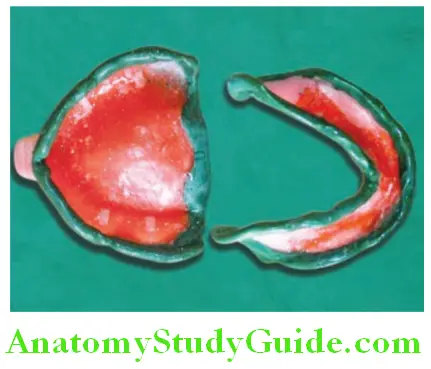
Materials used for Border Molding:
- Low fusing compound (greenstick compound)—most commonly used
- Polyether impression material
- Self-cure acrylic resin
- Impression waxes
- Tissue conditioner
- Pattern resin
- Wax (Adaptol)
Methods of Border Molding:
- Based on technique:
- Incremental or segmental technique
- Single step or simultaneous technique
- Closed mouth
- Open mouth
- Based on manipulation:
- Functional manipulation (movements provided by the patient)
- Manual manipulation (movements done by dentist by manipulating cheek and lips)
- Combination of functional and manual manipulation (some movements performed by patient and some done by dentist).
Final Impression Making
Final impression is made with custom tray which has better fit compared to the stock tray. Final impression is made after border molding is done. The impression materials used for final impression records fine details compared to primary impression. Selective pressure technique is used for making final impression.
Rationale/Need
- To record accurate shape of mucosa lining the residual ridge and foundation area
- To accurately record border width and height
- To accurately record border configuration
- To produce master cast on which stable and retentive denture base can be fabricated.
Materials used for Making Final Impression
- Zinc oxide eugenol impression paste
- Noneugenol impression paste
- Addition/condensation silicone impression material
- Polyether impression material
- Polysulfide impression material.
Zinc Oxide Eugenol Impression Paste:
Most commonly used material for making final impression is zinc oxide eugenol (ZOE) impression paste. Noneugenol impression paste is used when patient is suffering from smokers’ palate, dry mouth, submucous fibrosis, burning sensation of mucosa, and if allergic to eugenol. In severe undercut ZOE impression paste cannot be used as it become rigid after setting and cannot be removed without distortion,
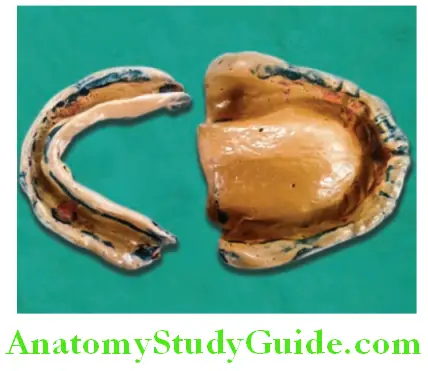
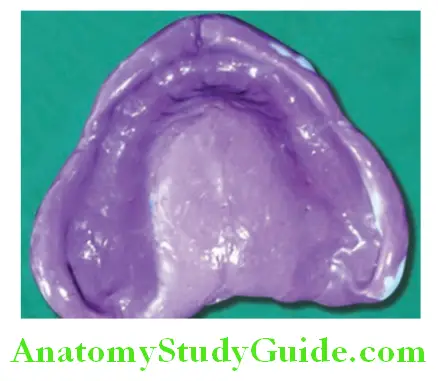
hence elastomeric impression materials (which are elastic after setting) are used in case of severe undercuts.
Elastomeric Impression Materials:
Sometime, elastomeric impression materials, i.e. polyether, addition silicone, condensation silicone or polysulfide can also be used to make edentulous impressions. Light body or medium body consistency of elastomeric impression material is used to make final impression of complete denture. Elastomeric impression is made when there is severe undercuts located at different areas of edentulous arch.
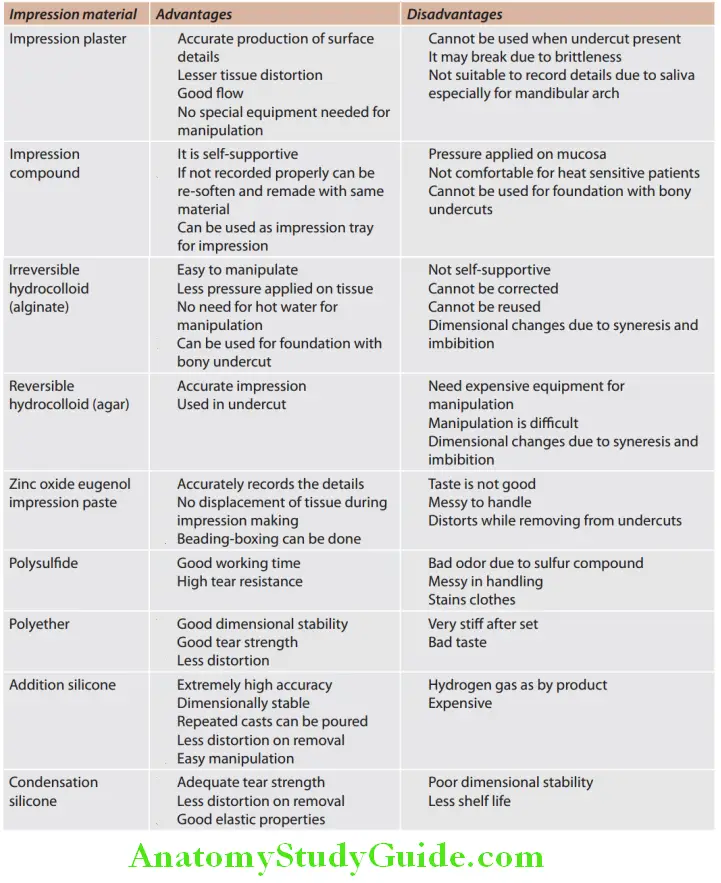
Various Impression Materials Used For Edentulous Impression

Leave a Reply