• Skip to main content
  • Skip to secondary menu
  • Skip to primary sidebar
  • Skip to footer
  • Anatomy
    • Anatomy Question And Answers
    • Face Anatomy
    • Neck Anatomy
    • Head Anatomy
    • Oral Anatomy
    • Lower Limb
    • Upper Limb
  • Endodontics
    • Paediatric Dentistry
  • General Histology
    • Oral Histology
    • Genetics
  • Pediatric Clinical Methods
  • Complete Dentures
    • Pharmacology for Dentistry
  • Medical Physiology
    • Body Fluids
    • Muscle Physiology
    • Digestive System
    • Renal Physiology
    • Endocrinology
    • Nervous System
    • Respiratory System
    • Cardiovascular System
    • Reproductive System
    • Oral Physiology
  • General Medicine
  • General Pathology
    • Systemic Pathology
    • Oral Pathology
    • Neoplasia
    • Homeostasis
    • Infectious Diseases
    • Infammation
    • Amyloidosis Notes
  • Periodontology
  • General Surgery
    • Basic Principles Of Surgery
    • General Surgery

Anatomy Study Guide

Anatomy Study Guide

  • About Us
  • Contact Us
  • Privacy Policy
  • Terms of Use
  • Disclaimer
  • Sitemap
Home » Paediatric Orthodontics An Overview Notes

Paediatric Orthodontics An Overview Notes

June 5, 2023 by vasantha Leave a Comment

Paediatric Orthodontics An Overview Introduction

Deciduous dentition is the foundation or arch template of permanent dentition.

Table of Contents

  • Paediatric Orthodontics An Overview Introduction
  • Categories Of Orthodontics
  • Summary

Each deciduous tooth serves its function, sets a pathway for the new tooth to occupy its seat and exfoliates.

The integrity of deciduous dentition has to be preserved for an optimal period to ensure a desirable exfoliation pattern.

Read And Learn More: Paediatric Dentistry Notes

Intact deciduous dentition and uneventful transition at the mixed dentition stage are highly essential for the integrity of permanent dentition.

It has to be ensured that the permanent teeth erupt in the right place at the right time.

Body Fluids Muscle Physiology Digestive System
Endocrinology Face Anatomy Neck Anatomy
Lower Limb Upper Limb Nervous System

This chapter gives an introduction to Paediatric Orthodontics that comprises the following efforts:

  1. Preserve the integrity of primary dentition till exfoliation
  2. Re­establish integrity distinctly lost/precarious
  3. Supervise the eruption of permanent teeth
  4. Identify altered eruption/exfoliation pattern/path Rearrange teeth in case of early distinct malarrangement or malposition.

Categories Of Orthodontics

Orthodontics can be categorised under three headings, namely preventive, interceptive and corrective orthodontics.

Paediatric orthodontics concentrates on the first two categories.

1. Preventive orthodontics: Preventive procedures are implemented to prevent the precipitation of malocclusion.

2. Interceptive orthodontics: Deviation from the normal eruption pattern or meal arrangement during the mixed dentition stage may become evident if preventive orthodontic procedures have not been performed at the right time or have been underperformed.

Interceptive orthodontic procedures are attempted in these situations to restore normalcy.

3. Corrective orthodontics: Pronounced malocclusion results when the indicated preventive and interceptive orthodontic procedures are not performed on time or underperformed.

An established malocclusion requires an orthodontist’s assistance for comprehensive care.

This is called corrective orthodontics. enumerates the orthodontic procedures indicated under the three categories mentioned above.
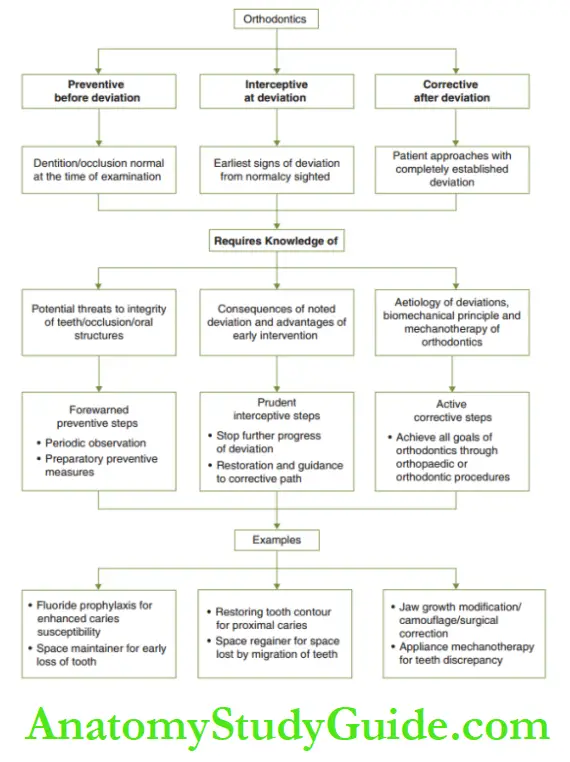
Paediatric Orthodontics An Overview Enumeration of preventive, interceptive and corrective orthodontic procedures

Summary

  1. Orthodontics can be categorised as preventive, interceptive and corrective orthodontics.
  2. Paediatric orthodontics concentrates on preventive and interceptive orthodontics.

Filed Under: Pediatric Dentistry

Reader Interactions

Leave a Reply Cancel reply

Your email address will not be published. Required fields are marked *

Primary Sidebar

Recent Posts

  • Esophagus Anatomy
  • Lacrimal Apparatus: Anatomy, Parts & Function
  • Scalp Temple And Face Question and Answers
  • Orbicularis Oculi Muscle Anatomy
  • Extraocular Muscles Anatomy
  • Ciliary Ganglion Anatomy
  • Femoral sheath Anatomy
  • Femoral Artery – Location and Anatomy
  • Adductor Canal: Anatomy And Function
  • Ankle Joint: Anatomy, Bones, Ligaments And Movements
  • Risk Factors For Breast Cancer
  • Cervical Tuberculous Lymphadenitis Notes
  • Carbuncles: Causes, Symptoms, and Treatments
  • Sinuses And Fistulas Notes
  • Cellulitis: Treatments, Causes, Symptoms
  • Pyogenic Liver Abscess: Causes, Symptoms, and Diagnosis
  • Acid Base Balance Multiple Choice Questions
  • General Surgery Multiple Choice Questions
  • Hypertrophic Scarring Keloids Multiple Choice Questions
  • Surgical Site Infection Multiple Choice Questions
  • Facebook
  • Pinterest
  • Tumblr
  • Twitter

Footer

Anatomy Study Guide

AnatomyStudyGuide.com is a student-centric educational online service that offers high-quality test papers and study resources to students studying for Medical Exams or attempting to get admission to different universities.

Recent

  • Esophagus Anatomy
  • Lacrimal Apparatus: Anatomy, Parts & Function
  • Scalp Temple And Face Question and Answers
  • Orbicularis Oculi Muscle Anatomy
  • Extraocular Muscles Anatomy

Search

Copyright © 2026 · Magazine Pro on Genesis Framework · WordPress · Log in