Sports Dentistry Introduction
Athletic injuries or injuries during various sports events are one of the common reasons for orofacial trauma.
Table of Contents
Sports dentistry focuses on the prevention of orofacial trauma caused due to various sports activities and the treatment of such traumatic injuries. The treatment of traumatic injuries has been dealt with. This chapter shall discuss the modes of prevention of sport-related orofacial injuries.
Read And Learn More: Paediatric Dentistry Notes
Predisposing Factors:
Traumatic injuries due to sports activities can have two predisposing factors, namely the type of game and the pre-existence of malocclusion.
Contact sports such as boxing, wrestling, and rugby have the highest proneness to trauma.
These are followed by outdoor, motion sports such as football and basketball where fall injuries are common.
No-contact sports where the individual players are unlikely to come in contact with each other or any object are less prone to sport-related dental injuries.
Some examples of such sports are tennis, badminton, and table tennis.
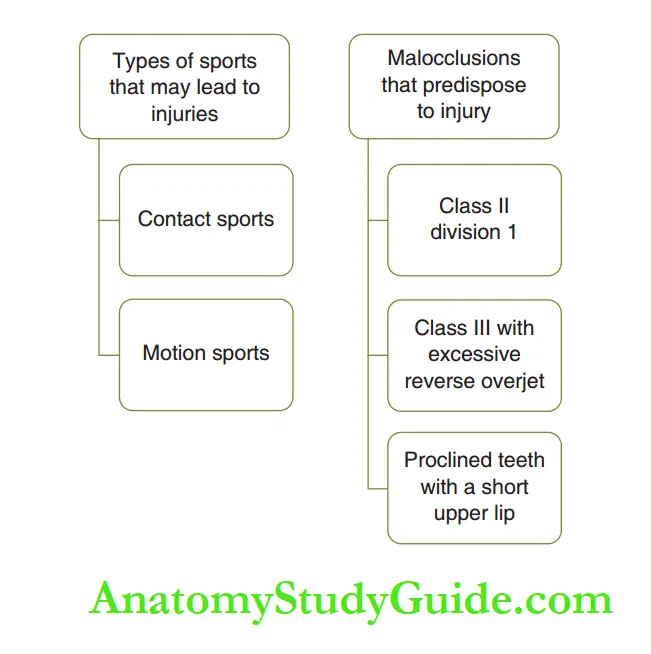
Malocclusion that can predispose to sport-related injuries is as follows:
- Class II division I with excessive overbite and overjet
- Proclined teeth (increased overjet) with a short upper lip
- Class III malocclusion with excessive reverse overjet
Prevention Of Sport Injuries
- Sport-related injuries can be prevented by the following three strategies:
- Creating awareness among playing children about the possibility of trauma during the game
- Correction of associated malocclusion to decrease the risk of orofacial trauma
- Use of mouthguards to protect the dental structure from being traumatized during play
Mouthguards
A mouthguard is an appliance worn to dissipate the trauma inflicted on the dental/oral tissues, thus preventing injury.
Mouthguards are mostly intraoral appliances covering the upper and lower teeth.
They are usually rubberized or resilient to absorb forces due to injury.
Continuous wear of mouthguards at organized sports activities can effectively reduce the frequency of trauma to teeth and decrease the severity of trauma if inflicted otherwise. Hickey et al. and Stengeret et al.
(1964) and Heintz (1968) concluded that an intraoral mouthguard is the single-most important device to prevent trauma to the teeth and jaws and to decrease the likelihood of jaw fractures.
Types:
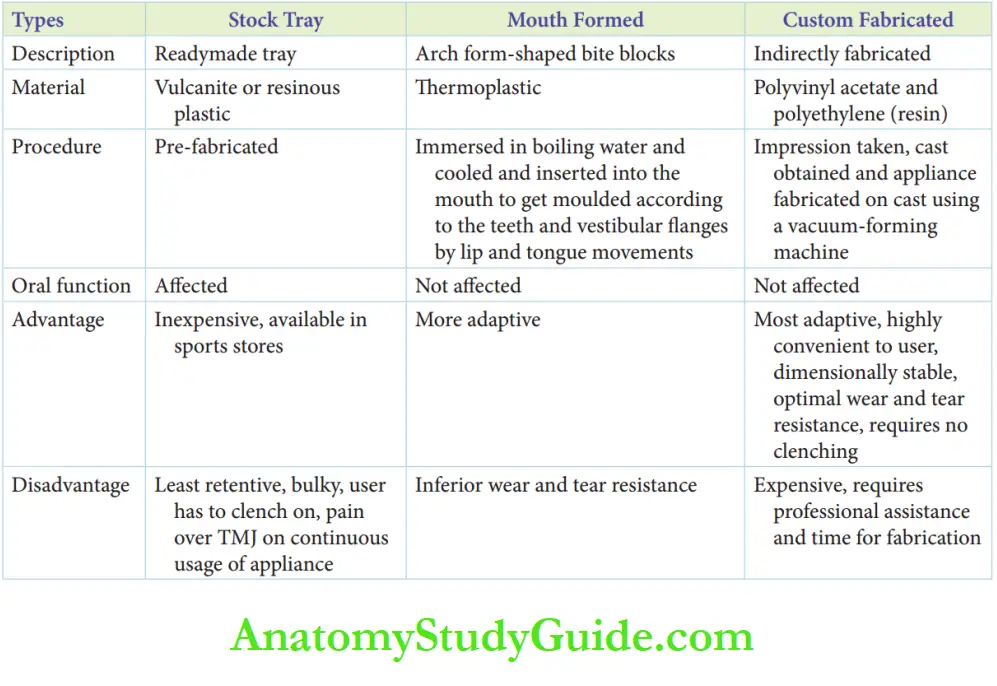
The American Society of Testing and Materials (ASTM) classified mouthguards into three types, which are as follows:
- Stock trays
- Mouth formed
- Custom fabricated
- Stock Trays
Stock trays are pre-fabricated or readymade trays. They are made of vulcanite or resinous plastic material.
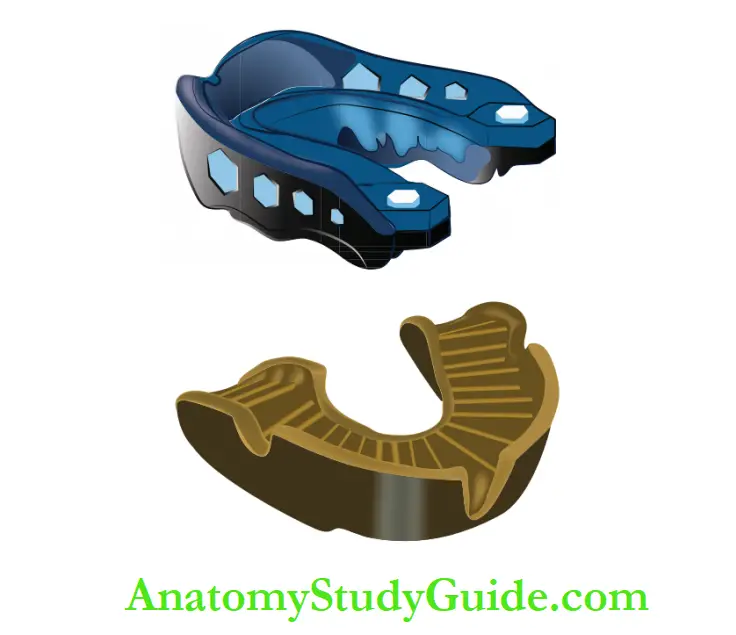
They are relatively inexpensive and are available in stores that deal in sports goods.
They are usually the least retentive and look bulky when worn. They retard normal oral functions such as breathing, swallowing, and phonation.
They are held in the mouth by asking the individual to clench the appliance.
Persistent contraction of masticator muscles can cause vague, diffuse pain over and around the temporomandibular joint region.
This mouthguard provides the least protection.
Mouth-Formed Mouthguards:
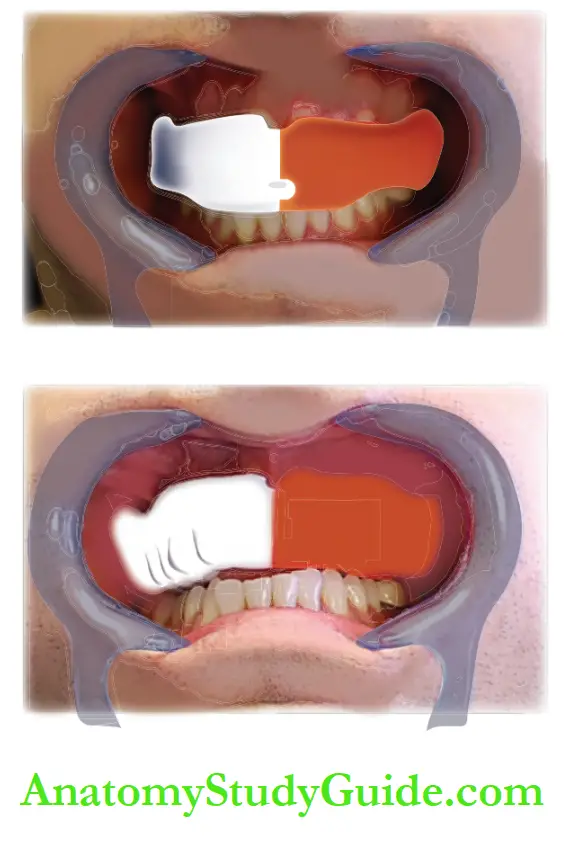
Mouth-formed mouthguards are parts of the stock tray type and are partially custom fabricated.
The mouth-formed variety is supplied in arch-form-shaped thermoplastic bite blocks.
It is immersed in boiling water and cooled to 132 °F.
When inserted into the mouth, the softened thermoplastic is molded according to the anatomic contour of the mouth, teeth, and vestibular flanges.
This type of mouthguard is more adaptive than stock trays and does not alter normal oral functions.
The wear and tear resistance of these mouthguards is inferior.
Custom-Fabricated Mouthguards:
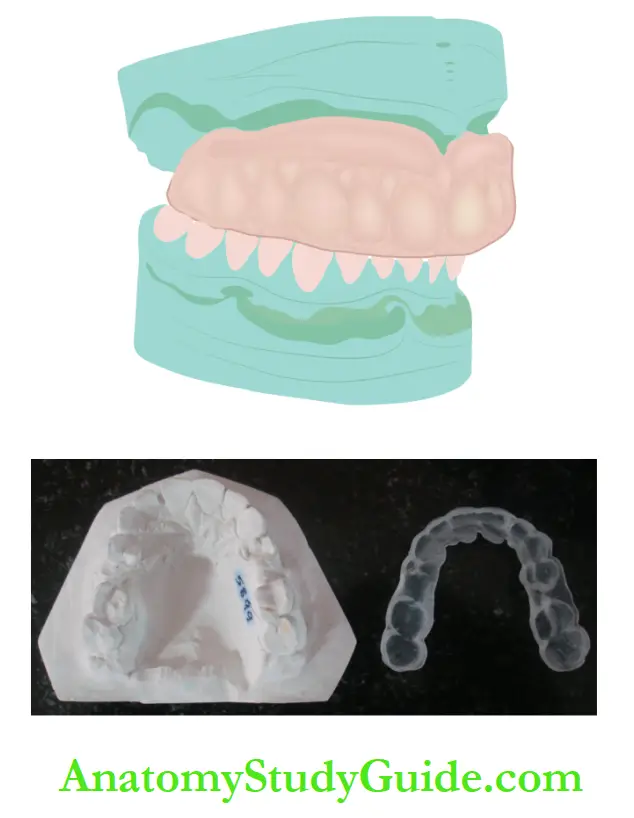
Custom-fabricated mouthguards are the most adaptive and of the highest convenience to the user.
They are self-retentive and require no active clenching. They do not alter/retard oral functions such as breathing, swallowing, and phonation.
They have optimal wear resistance and are dimensionally stable.
However, they are more expensive than stock trays or mouth-fabricated mouthguards sowing to the professional time and care involved in their fabrication. These mouthguards are indirectly fabricated.
Procedure:
Maxillary and mandibular impressions are made. The casts obtained are used for fabricating the mouthguard.
Polyvinyl acetate and polyethylene are the materials used for the fabrication.
A vacuum-forming machine is used for fabrication. A cold, wet dental model is cemented on a vacuum former.
A 5.5-inch square sheet of resin material is placed in the vacuum-formed chamber.
The chamber is heated till the material becomes 1 -2 inches. Then the heater is switched off and the vacuum is switched on.
The creation of a vacuum drags the softened resin sheet and adapts it perfectly over the contour of the cast. The vacuum is on for at least 2 minutes.
After cooling the model, it is soaked in water to facilitate the removal of the mouthguard from the cast. The excess is trimmed with sharp scissors and a utility knife.
The cut ends are polished with motor wheels. This variety of mouthguards is most commonly used currently.
Care Of The Mouthguards:
The mouthguard should be stored and handled appropriately to retain its adaptive capacity and enhance the longevity of life.
The storage and handling methods are listed as follows:
1. The mouthguard should be stored in a dry, clean container
2. After every use, it has to be washed well with toothpaste (cleaning agent) and water.
Every 3 months, the mouthguard should be checked for its adaptive capacity as the children (user) are growing.
When the children outgrow the guard, it may deliver much less safety owing to a decrease in adaptive capacity.
4. Mouthguards have to be included for the protection of facial tissues along with helmets, arm guards, chin guards, and groin guards during sports activities.
Sports associations/organizations, schools, and society as a whole should be made aware of the usefulness and necessity of mouthguards during sports.
Sports Dentistry Summary
1. Predisposing factors of trauma during sports:
- Type of game
- Contact sports
- Motion sports
- No contact sports
- Pre-existing malocclusion
-
- Class II Division I
- Class III with excess reverse overjet
- Increased overjet with the short upper lip
2. Prevention of sports injuries
- Creating awareness of injury during sports
- Correcting malocclusion
- Use of mouthguard
3. Mouthguard: Mostly intraoral appliance, of three types:
Leave a Reply